This digital humanities project draws from an exceptional source base: Cap-Français’s cadastres dating from 1776 (5 DPPC 49), 1787 (5 DPPC 49), and 1803 (5 DPPC 50). They form part of the Dépôt des Papiers Publics des Colonies, or DPPC held in the Archives Nationales d’Outre-Mer, located in Aix-en-Provence, France. The cadastres compiled for Cap Français in these years functioned as official imperial documents that captured crucial details about the town’s real estate value and ownership. These materials were a small part of a much larger administrative project begun in 1776 by the crown which involved gathering and preserving colonial records relating to the social, economic, and legal life of the colonies (censuses, notarial acts, parish registers, etc.). The cadastres were likely produced in triplicate, with one copy being sent to a repository in France organized by the Archives de la Marine et des Colonies and the others kept in local, colonial repositories. The Archives de la Marine et des Colonies supplemented their holdings in the nineteenth century through purchasing relevant materials as well as accepting donations. The 1776 cadastre was one such material purchased at an auction in 1826.
These rich cadastres provide crucial insight into the town’s demographic and economic life before and during the Haitian Revolution. While each cadastre varies in size and scope, they nonetheless offer fascinating peeks into the port town’s demographics and socio-economic dynamics. Some indicate only the identity of the owners while other cadastres have much more to say about the tenants (race, sex, marital status, profession) or about other residents of the house.
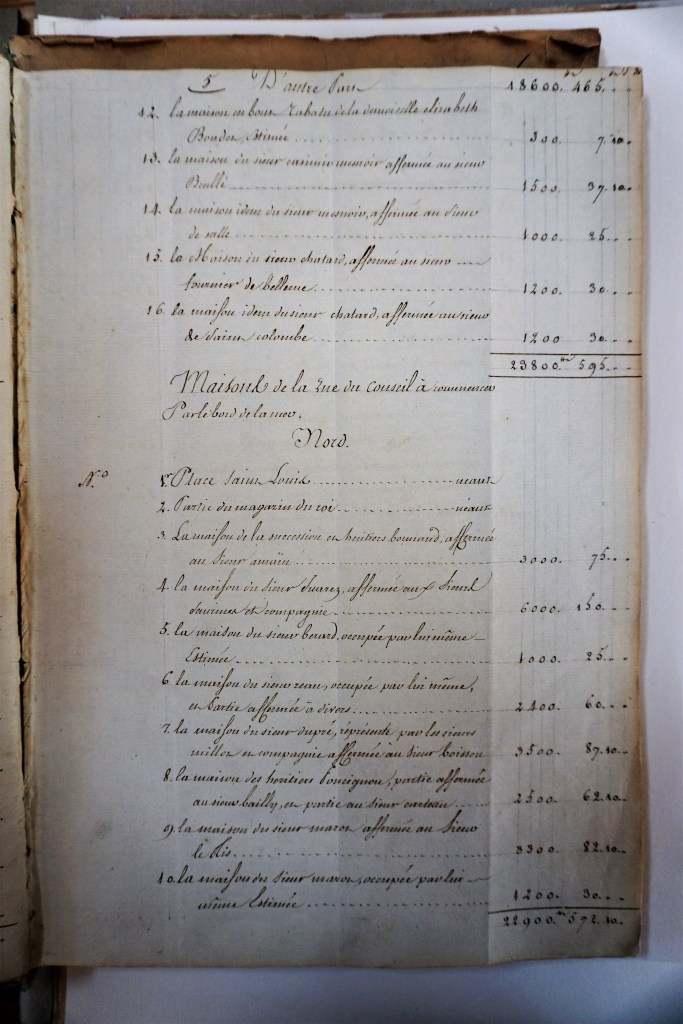
Dated April 29, 1776, the first cadastre was completed by councilors to the monarch, Nicholas Marie Urbain Mesnard Ducoudrai and Philippe Debrucourt. Mandated by the Conseil Supérieur of Cap Français, Ducoudrai and Debrucourt set out to list the names of property owners in the city. The purpose of the cadastre was to ensure the levy of a 2.5% duty on the annual rent (actual or theoretical) of their house(s). This levy was decided by the colonial assembly in Port-au-Prince on the 1st and 6th of April, per the order of the king. While all the major towns of Saint Domingue were impacted by the tax (except for Port-au-Prince, Léogane, Petit-Goâve and Jacmel), only the register for Cap Français survives. The extent of the data for the 1776 cadastre is breathtaking. The source outlines family name, marital status, skin color, sometimes the profession of the head of house, the amount of rent, and the material used to construct the house.

The second cadastre, which appears to be a copy of the original (or a copy of another copy), captures homeowner data for residents in Cap Français on November 11, 1787. The creation for the cadastre arose in response to an ordonnance passed on December 30, 1786, which required town residents to affix their house/residence number to the exterior of their dwelling. The resulting 39-page document captures the names of propriétaires along with the location and size of each residence, but nothing more. In all likelihood, this cadastre, as well as that of 1776, was acquired during the sale of the library of Monsier Bleschamps, ancien commissaire de la marine. Both documents were then copied and filed at the Dépôt des Papiers Publics des Colonies in 1826.

The final cadastre for Cap Français was conducted in 1803 during the Haitian War for Independence. On June 29, 1802, the impecunious French Commander-in-Chief, Charles-Victor-Emmanuel Leclerc, levied an impôt on the residents of the town to fund the war against the Armée Indigène. To guarantee payment, Leclerc’s representatives conducted a thorough census of the town and its immediate outskirts. The clerks documented the names of the heads of household and other non-dependents residing in the home, their occupation and class, their residence, peculiarities of the dwelling, and the tax burden each resident was to shoulder. The result of this recensement is a ledger nearly 300 pages long containing over 5,000 names. While earlier cadastres focused on the heads of household, this final cadastre captured the names of most men and women living in a particular home. Dependents—married women and children—were likely excluded from this list, however. Whereas earlier cadastres privileged data about the town’s real estate, capturing the location and size of each house or building, the 1803 report focused heavily on people—taxpayers who became crucial sources for funding Napoleon’s war in Saint Domingue.
 In the Streets of Le Cap